Clinical evidence. Real world results.

Clinical evidence.
Real world results.

FEATURED STUDIES


Explore the evidence

Dive deeper into the studies, data, and supporting research behind Steriwave.

Effectiveness of prophylactic intranasal photodynamic disinfection therapy… for surgical site infection prophylaxis in adult spine surgery

In >13,000 spine surgeries over 14 years, nasal PDT with CHG wipes reduced SSIs by 67% and saved ~$2.5M annually.

Moskven et al. Can J Surgery 2023.

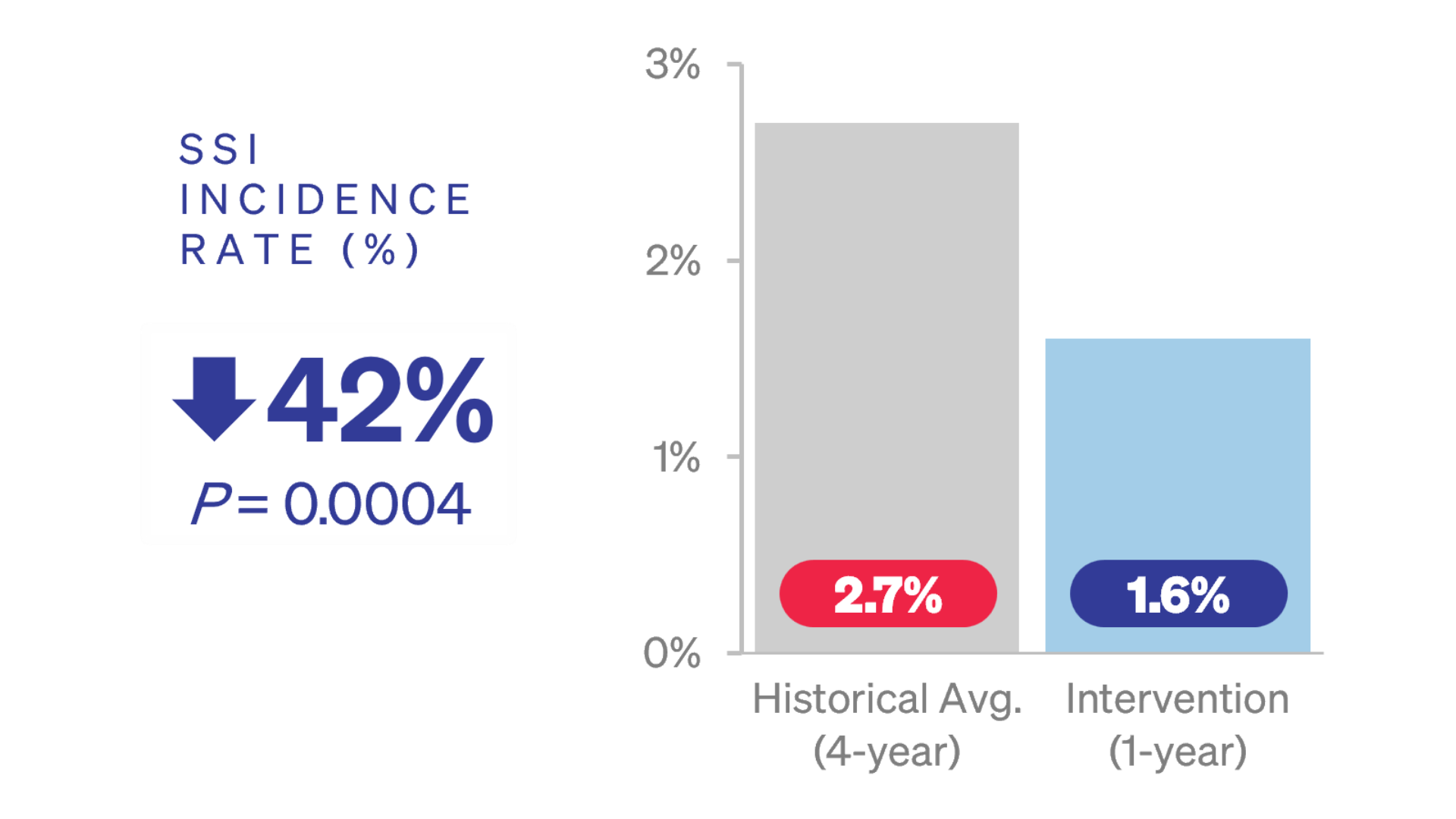
Nasal photodisinfection and chlorhexidine wipes decrease surgical site infections

Historical control of 3,000+ major surgeries; nasal PDT + CHG wipes reduced SSI rates by an average of 42%.

Bryce et al. J Hosp Infect 2014.

Pre-op Nasal Decolonization via Photodisinfection: A Pilot Study in Spinal Surgery Procedures at the Ottawa Hospital

Pilot spine surgery study; nasal PDT reduced antibiotic use, length of stay, readmissions, and ED visits.

IPAC Canada 2023 (poster).

Shining a Light on Nasal Photodisinfection: Prevention of SSI in Cardiac Surgery

Steriwave nasal PDT replaced mupirocin; cardiac SSI rates fell 32% with 94% compliance and no adverse events.

AMMI Canada–CACMID 2024 (poster).

Pre-operative decolonization does not adversely affect the microbiologic spectrum of spine surgical site infection

Nasal PDT lowered SSI rates while preserving infection microbiology, unlike mupirocin or intra-wound antibiotics.

Singh et al. Canadian Spine Society 2020 (abstract).

Impact of Nasal Photodisinfection on SARS-CoV-2 Infection in an Industrial Workplace

Application of nasal photodisinfection among workers reduced SARS-CoV-2 infection rates, supporting its potential in preventing respiratory virus transmission in occupational settings.

Rusk R, Hodge J. 2021.

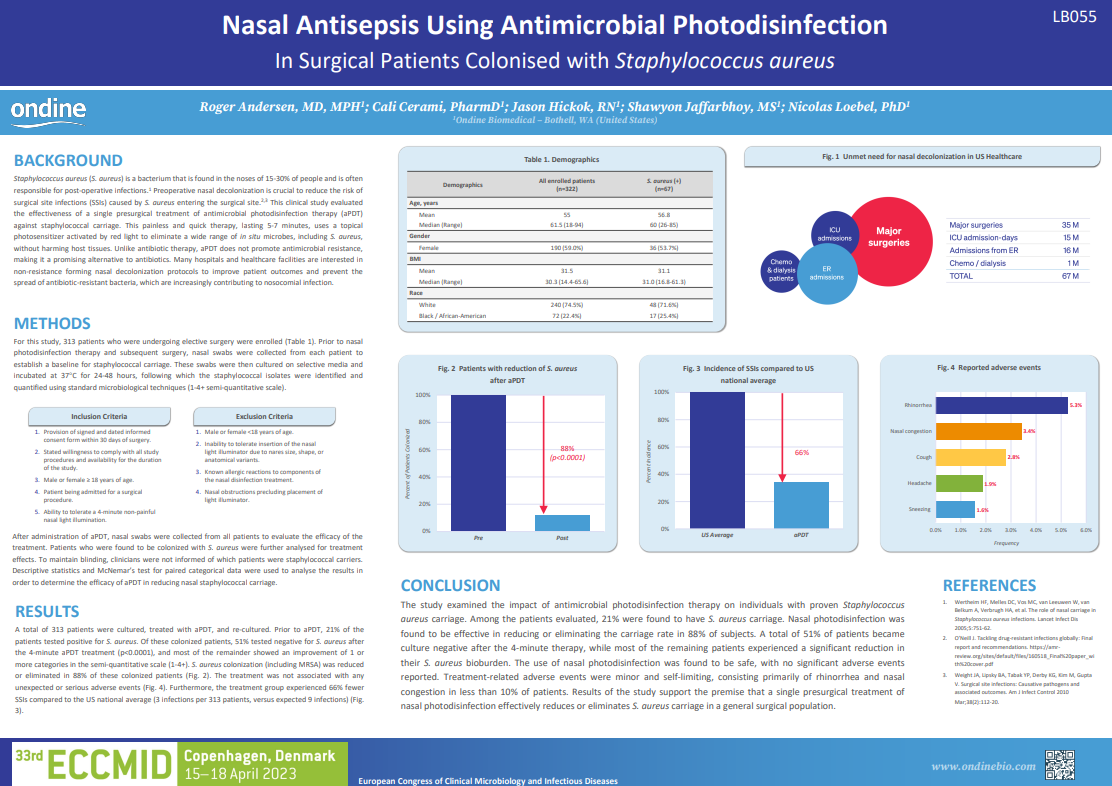
Nasal Antisepsis Using Antimicrobial Photodisinfection in Surgical Patients Colonized with Staphylococcus aureus

Single pre-surgical nasal photodisinfection eliminated S. aureus carriage in 88% of patients and reduced SSI rates by 66%.

Andersen R, Cerami C, Hickok J, Jaffarbhoy S, Loebel N.
Ondine Biomedical, 2023 (poster).

Photodynamic Nasal SARS-CoV-2 Decolonization Shortens Infectivity and Influences Specific T-Cell Responses

Nasal photodisinfection accelerated viral clearance and modulated T-cell immune responses in SARS-CoV-2–positive patients.

Fernandez-Montero A, et al. 2023.

Translational Feasibility and Efficacy of Nasal Photodynamic Disinfection of SARS-CoV-2

Nasal photodisinfection achieved up to 6-log viral inactivation in vitro and reduced SARS-CoV-2 RNA in 90% of clinical samples.

Pires L, Wilson C, Bremner R, et al. 2022.

Impact of Nasal Photodisinfection on
ICU-Acquired Pneumonia

Nasal photodisinfection in critically ill patients reduced hospital- and ventilator-associated pneumonia by 26.8% and significantly lowered nasal pathogen burden, with no safety concerns.

Rohrs et al. Critical Care, 2026.

Photodisinfection Therapy:
Essential Technology for Infection Control

Given its demonstrated ability to eradicate pathogenic microorganisms without inducing resistance following repeated exposure to therapy, aPDT is likely to evolve into an essential tool for infection control and become a vital part of the solution to the global AMR crisis.

Meller et al. TIPS 2020.

Antimicrobial photodynamic therapy for nasal decolonization: comparison of in vitro model to in vivo trial outcomes

In vivo responses followed in vitro modeled outcomes, proving Steriwave highly effective against methicillin-sensitive as well as multidrug-resistant S. aureus.

Loebel et al. Photodiagnosis and Photodynamic Therapy 2024

Microbiome analysis of photodynamic
nasal decolonization

Results from exploratory study of 35 healthy volunteers treated with Steriwave showed photodisinfection significantly reduces pathogens in the nose – a reservoir for bacteria – yet does not produce long-term adverse effects on the nasal microbiome.

Ondine presentation at SPIE Photonics West conference 2024

Effective Biofilm Eradication on Orthopedic
Implants with Methylene Blue Based
Antimicrobial Photodynamic Therapy In Vitro

aPDT effectively eradicated common periprosthetic joint infection (PJI) pathogens on arthroplasty materials without damage to the materials, suggesting that aPDT could be used as a novel treatment method, replacing current, more invasive approaches and potentially shortening the antibiotic treatment in PJI.

Prinz et al. Antibiotics 2023

Antimicrobial Photodynamic Therapy Against Extensively Drug-Resistant (XDR) Gram-Negative Isolates With Novel Antibiotic Resistance Factors

Steriwave is highly effective against all tested XDR Gram-negative strains within less than 20 seconds of treatment and promoted greater and faster bactericidal effects when compared to treatment by chlorhexidine gluconate (CHG) alone or aPDT with methylene blue (MB) alone, indicating a synergistic combination of both active components.

Ondine poster presentation at ICPIC2023.

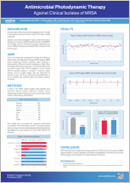
Antimicrobial Photodynamic Therapy Against Clinical Isolates of MRSA

aPDT eliminated more than 99.9% of each isolate in only 60 seconds, irrespective of the isolate’s antibiotic resistance.

Ondine poster presentation at the Infection Prevention Society Conference 2022.

Antimicrobial Photodynamic Therapy (aPDT)
Against ESKAPE Pathogens

aPDT eliminated all ESKAPE pathogens with a high degree of efficacy. ESKAPE pathogens are the most virulent and dangerous pathogens responsible for some of the deadliest healthcare-associated infections (HAIs).

Ondine poster presentation at the World Anti-Microbial Resistance Congress 2022.

Absence of Bacterial Resistance Following Repeat Exposure to Photodynamic Therapy

aPDT is effective in the eradication of pathogens including antibiotic resistance strains. Repeated sub-lethal exposure does not induce resistance to subsequent aPDT treatments, which represents a significant advantage of aPDT over traditional antibiotics.

Pedigo et al.SPIE 7380 Photodynamic Therapy: Back to the Future 2009.

The role of nasal carriage in
Staphylococcus aureus infections

Identifying the nose as the primary source of S. aureus causing HAIs/SSIs, with ~80% attributable to nasal carriage.

Wertheim et al. Lancet 2005.

SHEA Compendium 2023

The 2023 SHEA Compendium now designates preoperative decolonization with an anti-staphylococcal agent for cardiothoracic and orthopedic surgeries as an Essential Practice, rather than an Additional Approach.

Yokoe DS et al. Infect Control Hosp Epidemiol. 2023.

Strategies to Prevent Surgical Site Infections in Acute-Care Hospitals: 2022 Update

Reclassified decolonization of surgical patients with an anti-staphylococcal agent for cardiothoracic and orthopedic procedures from an Additional Approach to an Essential Practice.

Calderwood MS, Anderson DJ, Septimus EJ, et al. Infect Control Hosp Epidemiol. 2023

Association of a Bundled Intervention With Surgical Site Infections Among Patients Undergoing Cardiac, Hip, or Knee Surgery

Bundled protocol reduced SSIs but only achieved 39% compliance with nasal mupirocin, underscoring adherence as critical.

Schweitzer et al. JAMA 2015.

Targeted versus Universal Decolonization to
Prevent ICU Infection

Universal decolonization proved more effective than targeted approaches, expanding benefit across ICU populations.

Huang et al. NEJM 2013.

The cost of managing complex surgical
site infections following primary hip
and knee arthroplasty

Complex SSIs after joint replacement carried costs far exceeding average estimates for surgical site infections.

Rennert-May et al. ICHE 2018.

Hallmarks of ideal decolonization


check icon
Safe
check icon
Clinically proven
check icon
Rapid
check icon
Easy to use
check icon
Broad-spectrum
check icon
High compliance
check icon
No resistance
check icon
Cost effective

Steriwave checks every box!
Hallmarks of ideal decolonization

 
check icon
Safe
check icon
Clinically proven
check icon
Rapid
check icon
Easy to use
check icon
Broad-spectrum
check icon
High compliance
check icon
No resistance
check icon
Cost effective

Steriwave checks every box!

Get started with Steriwave.
Contact our team.

Get started with Steriwave.
Contact our team.